
Tonawanda Iron and Steel (Niagara River Iron Company)
Dublin Core
Title
Tonawanda Iron and Steel (Niagara River Iron Company)
Description
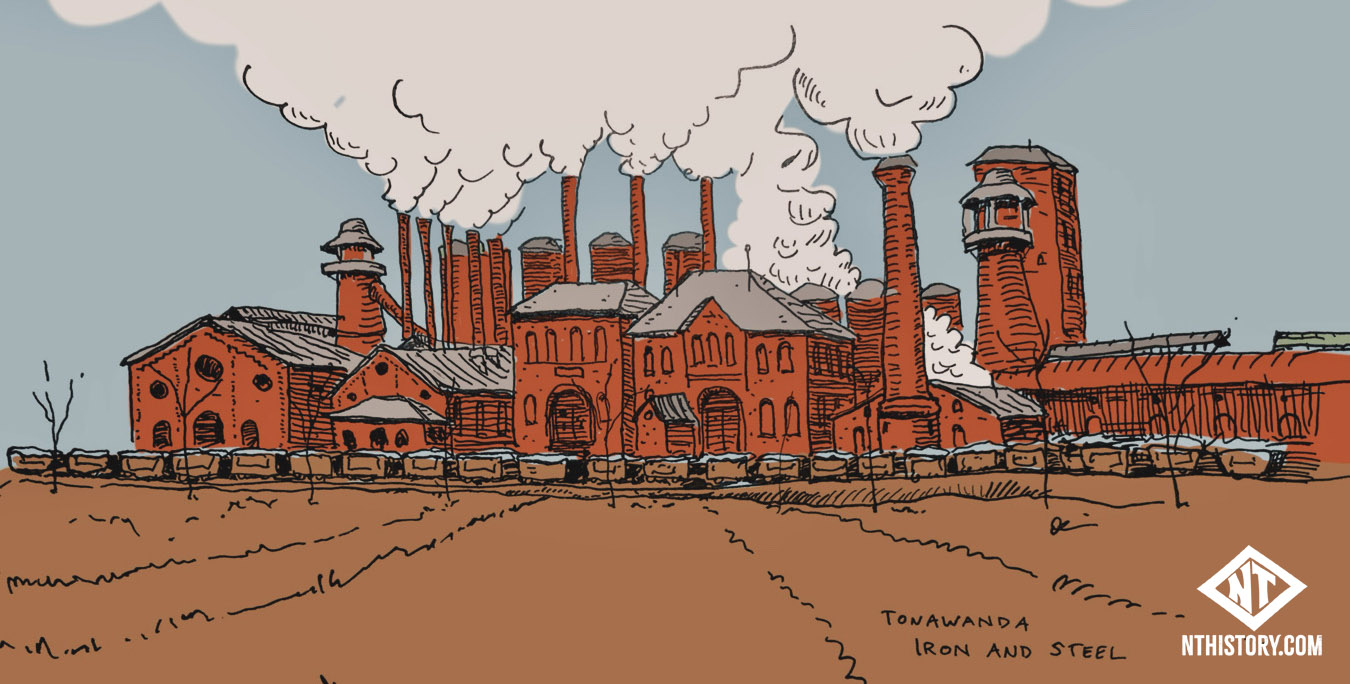 Illustration: Dennis Reed Jr., 2025.
For a century, a massive riverfront iron works dominates the skyline of North Tonawanda near Wheatfield Street and present-day Fisherman's Park. The furnaces cast a ruddy glow over the west, and power the birth of the village of "Ironton," later known as "The Avenues."
From History of Niagara County (1878):The Niagara River Iron Company was formed in pursuance of the general manufacturing law, in 1872, with a paid-up capital of $400,000. The first purchase of real estate was of 165 acres from M. Bush. The buildings were erected in 1873, and manufacturing operations commenced the same year. The engine house stands in a prominent position, and by one not knowing its design might be taken for an elegant mansion or villa; the building is 68 by 74 feet, with a proportionate elevation, and finished in tasteful style. The boiler house, judiciously separated, located 45 feet by 70, contains ten ponderous boilers, four feet in diameter and sixty feet long; an octagon chimney eighty feet high rises in front. The blast furnace was constructed to run out fifty tons of pig iron per day, and is 60 by 200 feet and two stories high; a tower rising above the rounded kert contains the machinery for elevating ore and brick by steam power. The oven is 30 by 41 feet, with iron-bound exterior. The buildings named are massive and substantial brick erections, upon stone foundations. The stock house is a frame building, 72 by 500 feet and two stories high.Pascal P. Pratt, a "hardware man" from Buffalo, is president and principal stockholder.
The dock fronting on the river is 500 feet in length, reaching ten feet depth of water. Located upon the dock is an engine for raising freight from the vessels.
Two branch tracks of the Central railroad pass over the docks and into the stock house, to deposit and remove material. The buildings cover an area of four acres.
The trustees are P. P. Pratt, president; Josiah Jewett, vice-president; S. S. Jewett, H. H. Glenny, George B. Hays, F. L. Danforth and B. F. Felton. During the present general depression in business the works are not operated; but as they are controlled by men of permanent wealth, willing to use it and able to hold their own until the day dawns upon brighter prospects, the advantages of this great concern will yet be felt by the community that has clustered about it in anticipation. The premises and machinery are kept in the most perfect order and neatness under the care of Alexander Reid.
Mr. [Pascal P.] Pratt also helped to organize the Niagara River Iron Company in 1872. That company operated a blast furnace in North Tonawanda capable of turning out fifty tons of pig iron daily. Pascal Pratt was President of the firm, and among the other principals was S. S. Jewett. This company was later succeeded by the Tonawanda Iron and Steel Company, with William A. Rogers as President.
- Olmsted in BuffaloBy 1875, in the midst of a general depression in the iron industry, the works are stopped, and lie dormant for years, possibly the next 14.
In January 1889 it is reported that the Baird Bros. of Ohio will buy the plant and resume operations. It will require about $50K. 30 workers are expected in March. Ore begins arriving in great quantities in June, and on August 28 the furnace roars again. 100 men work the facility, day and night. The production of 100 tons of iron and steel a day is planned.
Seemingly owned at one point by "Rogers, Brown and Company, one of the largest iron companies in the country."
The iron plant draws workers to the area, many Hungarian and Polish, who settle in a village called "Ironton," just north of North Tonawanda proper.
Frank Burkett Baird (b.1852 d.11/15/1939) organizes the Tonawanda Iron & Steel Co, in 1899. (Baird's singular accomplishment is as "Father of the Peace Bridge" - Buffalo Architecture & History).
The new venture is a success, and expanding. President Rogers. New "monster" engine in June 1896.
President McKinley fires up its mighty Furnace B with great ceremony and the flip of a switch from his home in Ohio in November 1896.
Somewhere around 1912 poor management and a poor economy stop the furnaces again. The plant lies unused until purchased by Tonawanda Iron Corp. in 1922.
Gilmore.
By 2017, the site has been cleared and converted into a small medical park and Fisherman's Park.
Source
"Tonawanda Iron Corp., Is One of Largest Manufacturers of Pig Iron." Tonawanda News, 1929 (in this collection).


Head furnace man dies in Buffalo when furnace fails, article (Niagara Falls Gazette, 1874-10-28).jpg


Ore arriving in great quantities for iron works, article (Suspension Bridge Journal, 1889-06-01).jpg


