
John and Hannah Johnson
Dublin Core
Title
Description
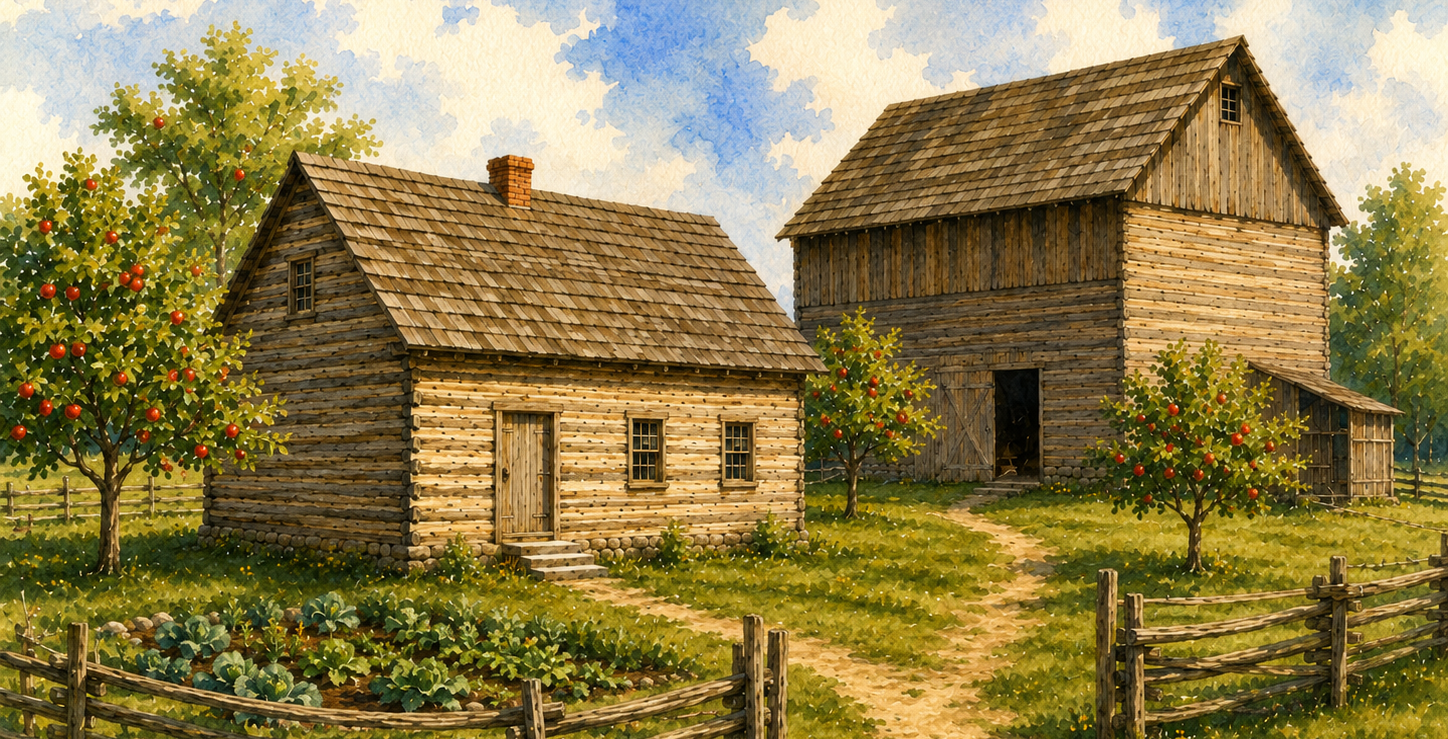 The Johnsons lived in a small frame house on a 12-acre farm in the area of present-day South Meadow Drive. Photo made with AI.
 Around campfires and during sleepovers, under covers and under stars, generations of North Tonawanda children heard the tale of “Black Hannah.” It was whispered that she was an escaped slave from the South, a fortuneteller, a seer of past lives who was silent about her own beginnings. Ancient beyond estimation, she was said to keep company with unseen forces in a shack in the primordial woods at the village edge. After she died, folks said strange flowers sprung up around the place—a sign that Hannah had never entirely belonged to this world, or that her spirit refused to leave her old home.
Her real name was Hannah Johnson.
Hannah Johnson’s story is one of those local legends where fact and invention have grown together until the roots are hard to untangle. How did a Black woman born a slave come to settle in a small, overwhelmingly white canal town—one that, it needs to be said, had a reputation for hostility toward Black people? Was she connected to the Underground Railroad, as some have hoped to prove? And if her 1883 obituary is right that she was buried in Sweeney Cemetery, where is her grave?
The records are spare, but they show John and Hannah living separately from any white household and working in agriculture. Later memory would make Hannah solitary, supernatural, and half-lost in the trees. The documents suggest something more complicated: a Black couple trying to build and defend a life in a community that was not always eager to see-or remember--them clearly.
Hannah is the subject of a song by my musical gang Yellow Jack on our album "A Horse Apiece"
Dr. Jesse Fayette Locke (1810-1861).per

Ancestry Link 1810-07-21 in Hollis Center, Maine. 1830 Limerick School in Biddeford Me 1833 Main Temperance Society 1834 College in Maine 1834…
Chadwick family on ship manifest, Samuel - NYM237_19-0362.jpg

John Chadwick Sr. is 41, profession: farmer
7 year-old John Chadwick comes to the United States (New York City) May 27, 1833 aboard the Samuel.…
Solomon G. Haven to Henry Roop, deed (Book19 p503 1 of 2, 1835-11-19).jpg

By late 1835, Solomon G. Haven was already treating Lot 10 as property in which he held a transferable interest, and he conveyed an undivided…
William Willink et al to Solomon G. Haven, mortgage for Great Lot 10 (1836-10-27).jpg

Mortgage;
Liber 18 of Mortgages, page 365 — the 1843 discharge.
Deed: Book 22 p 186
AI Transcription:
This Indenture, Made this twenty seventh…
John and Hannah Johnson, collected federal and state census information.doc

1810 U. S. Census Town of Cambridge, Washington County: James W. Peters household shows one enslaved person; 0 free whites 0-25; 1 free white male…
John Johnson household (U.S. Census, 1840).jpg

AI Summary:
In the 1840 census for Wheatfield, John Johnson appears as the head of a small free Black household of three. The visible age columns…
Solomon G. Haven to Thomas Bolton, deed (1840-09-14).jpg

Haven sells his other half of Lot 10 5 years after selling the first. The consideration was $1,000, which is much higher than the earlier Roop…
Locke and Hug receive undivided one-half of Lot 10 from Boltons of Cleveland for $700, indenture, transcription (1844-07-01).jpg

AI: "They bought half ownership of the whole 124-acre lot."
Margin / index text
Thomas Bolton & wife
To
Jesse F. Lock & Jacob Hug.
Lock and…

John, Hannah Johnson and others (U.S. Census, 1850).jpg

480 "Value of Real Estate owned"; the other tick is for "Persons over 29 years of age who cannot read or write."
"United States Census, 1850,"…
Drs Jesse Locke and Hoyer, journal info (1850-1852).jpg

From Historical Society of the Tonawandas:
Taken from an inventory of all historical record repositories in Erie County back in 1983. His journal…


Johnson 12-acre farm and house in 1852, approximate location on modern streets (1852).png

The 1860 map seems to show a different location
Jesse F. Locke land sales to John Chadwick (1853-11-02, 1859-04-01).jpg

1853-11-02
$500 for a 31-acre strip in center of Lot 10 ($16.13/acre)
1859-04-01
$1550 for a 31.5-acre strip along right edge of Lot 10…


Jesse F. Locke surrogate court documents, transcripts (1861-1865).doc

Jesse F. Locke dies March 12, 1861, without a will. The land John and Hannah Johnson have been living on is believed to be his. His old pal Lewis S.…


Locke cemetery plot deed for children, transcription (1865-01-03).jpg

AI Transcription:
Cemetery Association Deed
Know all Men by these Presents, That the Colonel John Sweeney’s Tonawanda Rural Cemetery…

Pickard family get Jacob Hook's land south of Johnsons, notice (1866-07-09).jpg

By 1866, the land immediately south of the Johnson twelve-acre corner was being sold under court judgment against Jacob Hook and others. That helps…


Caroline Bateman (Chadwick) communicant at St. Mark's Episcopal Church (1871).jpg

New Brunswick-born wife of John Chadwick, who will be dropped off the rolls according to the note in 1874, having not been to church in three years.

Johnsons quit-claim their 12 acres to John Chadwick for $1, indenture and deed, X marks, transcription (New York Land Records, 1873-07-08).jpg

John Johnson to Chadwick (Index of Deeds) 161:78 (Lot 10) 12 Acres - On July 8, 1873, John and Hannah sell the land to Chadwick for $1.
AI…
John Johnson burial record (St. Mark's Parish Register Book 1, 1873-07-11).jpg

The age at death of 73-74 (even its uncertainty) make this a good candidate for being John Johnson, husband of Hannah Johnson. July 9, 1873 is given…
John Fonner to John Chadwick, Deed Covenant against Grantor (NY Land Records, Vol.141, p.547-8, 1874-07-25).jpg

*AI Transcription* Brief summary The 1874 Fonner-to-Chadwick deed conveys the northwest part of Lot 10, Township 12, Range 8 in Wheatfield: a…

Franklin Warren v John Chadwick, charges defendant owes money and used property for two years, summary (Niagara County Supreme Court, 1876).png

Full version in Google Books, extremely detailed, 100 pages of arguments, points and testimony. Franklin Warren was a teamster, hired out to William…
Court of Appeals Case No. 254, Folios 10851–1089; John Chadwick v. John Fonner et al., 1876.pdf

Court of Appeals case and exceptions in the Johnson/Fonner land dispute, 1849–1876
Chadwick, Johnson and Sherman v. Fonner, report (Reports of Cases Heard and Determined in the Supreme Court of New York, Vol. 13, 1876)

This appellate decision [later reversed?] upholds a referee judgment confirming that Johnson held an equitable title (a court-recognized right to the…

Chadwick, Johnson and Sherman v. Fonner reversed, new trial granted (Reports of Cases Decided in the Court of Appeals of the State of New York Volume 69, 1878, 1877-04-24).jpg

AI: "In which the Court reversed the General Term decision printed at 6 Hun 543 and granted a new trial on the ground that Johnson’s own testimony…
New trial in Johnson-Fonner property dispute scheduled at Lockport, article (Tonawanda Herald, 1878-04-18).jpeg

Clipped by Bille.

John, Hannah and Daniel Chadwick, Sweeney street (St. Mark's Parish Register 2, c1879).jpg

John, sister and son on Sweeney Street. Not really sure of the date since not dated in register.
Fonner v. Johnson, Fonner keeps title (69 N.Y. 404, 1879-11-11).png

AI summary: "Fonner actually first took title in **April 1868**, when he bought the 62‐acre tract (including the 12 acres in dispute) from Locke’s…


Fonner to Chadwick, 62 acres for $5,200, formality (Index of Deeds 154 p153, 1881-05-11.jpg

This never takes effect; the sheriff's sale actually transfers title


Hannah Johnson, obituary (Tonawanda Enterprise, 1883-06-23).jpeg

AI transcription:
Hannah Johnson, the old colored lady known as “Black Hannah,” the fortune teller, who has occupied a house on J. Chadwick’s farm…
Black Hannah Gone, article obituary, transcription (Tonawanda Herald, 1883-06-28).jpg

**Black Hannah Gone**
Early last Friday morning, at a few minutes after one o'clock, Hannah Johnson, familiarly known as "black Hannah," and "aunt…
John Chadwick in court over cow with Old Man Behring, over alleged barn arson with Oldenburgh, articles (Tonawanda Herald, 1883-1885).jpg

Clippings by Bille


Chadwick called untrustworthy by many Tonawanda heavies in unrelated trial v Hewett, plaintiff (Supreme Court of New York, 1894).png

Payne, Felton Kent and others say defendant Chadwick's reputation for veracity is "not good." Defendant does summon a few middlng defenders. B. L.…


John Chadwick land to be auctioned, article (Tonawanda News, c1902-07).jpg

AI Transcription:
SUPREME COURT, NIAGARA COUNTY.
Annie C. Davis, as Executrix, etc., vs. John Chadwick, et al.
In pursuance of a judgment of…
Hints were all wasted, Black Hannah, article (...Times, 1903-12-13).jpg

Mistake-riddled account only 20 years after Hannah's death. AI Transcription: Special to THE TIMES, NORTH TONAWANDA, Dec. 12.—While negroes have…


Kluxers carry holiday cheer at Tonawanda, article (Courier-Express, 1924-12-24).jpg

The cross they burn is near the old Felton High School, a block away from Sweeney Cemetery.


Jacobs Orchard platted, prompts Black Hannah recollections, article (Tonawanda News, 1938-05-05).png


Spring Sends Memory Back to Black Hannah and Old Days of NT, article (Elizabeth Wherry, Tonawanda News, 1961-04-01).png

AI Transcription:
Spring Sends Memory
Back to Black Hannah
And Old Days of NT.
By ELIZABETH WHERRY
Of The NEWS Staff
Rake in hand, you…


John and Hannah Johnson appearances in U. S. Census (Bille, 1840, 1850, 1860, 1880).jpg

Compiled by Dan Bille. Scribbling by me.

"Hannah and John Johnson Home," transcribed article (Survey of Sites Relating to the Underground Railroad in Niagara region, 1820-1880).pdf

From page 192: Hannah and John Johnson HomeNorth of Sweeney Street and State DitchLot 10North Tonawanda, New YorkSignificance: John Johnson, born in…
Alleged grave of Hannah Johnson, Sweeney Cemetery, photo (NOT her grave), photo (Dennis Reed Jr, 2012.jpg

Identified by an old-timer as her grave. Not believed to be true.

Interview about "Black Hannah" Johnson with descendants of Zaggel family, transcript (2019-10-12).htm

In October 2019, descendants of the Zaggel family, Marie A. Sommer and Roberta, met with me at Sweeney Cemetery to share their family’s long-held oral…
Governor Joseph Christopher Yates home and environs, Schenectady, New York; photo gallery (2021).jpg

The household where Hannah Johnson was born c.1799 still stands at 17 Front Street in the historic Stockade District in Schenectady, New York. The…

